




Why Companies Thrive on the Fivefold While Churches Ignore It
Today’s blog is a re-post from the StarfishYoU SubStack.
Several years ago, my wife and I sat on the couch late at night and watched a random documentary on Netflix called “Happy”, which explores the science of human happiness through years of research and interviews with people of all walks of life across 14 different countries. They “discovered” that a few of the greatest factors of happiness are (1) belonging to a healthy community of loving relationships (2) a growing awareness and practice of your passion (3) serving others. My sarcastic comment as the credits scrolled, “would have saved them a whole lot of time and money to just read the Bible.”
You’ve probably had this experience too, maybe numerous times. Watching the world spend countless time and resources coming to revelatory conclusions that are self-evident in the Bible’s inspired pages, what is sometimes called “common grace” or “general revelation”.
I had a similar experience 13 years ago taking a graduate level course on Organizational Dynamics, built heavily around the classic text “Corporate Lifecycles” by Ichak Adizes, written nearly 40 years ago. In his evidence-based diagnosis of what makes corporations start, grow, decline and die, Adizes offers (1) a 10-stage organizational life cycle (pathway) (2) four core organizational functions (3) how those functions are properly deployed to start and grow a corporation (4) how those functions can eventually get disordered leading to organizational decline and death.
I wasn’t far into the class before realizing this was actually a brilliant articulation of APEST, that the business world had discovered and was now heavily leveraging as a roadmap to success, resulting in a sea of evidence-based insights that the church could carefully learn from (*carefully* because we all know that not everything from the business world is meant to be learned by other sectors, like the catastrophe of CEO leadership).
The Four Core Corporate Functions (Adizes PAEI vs. Ephesians APEST)
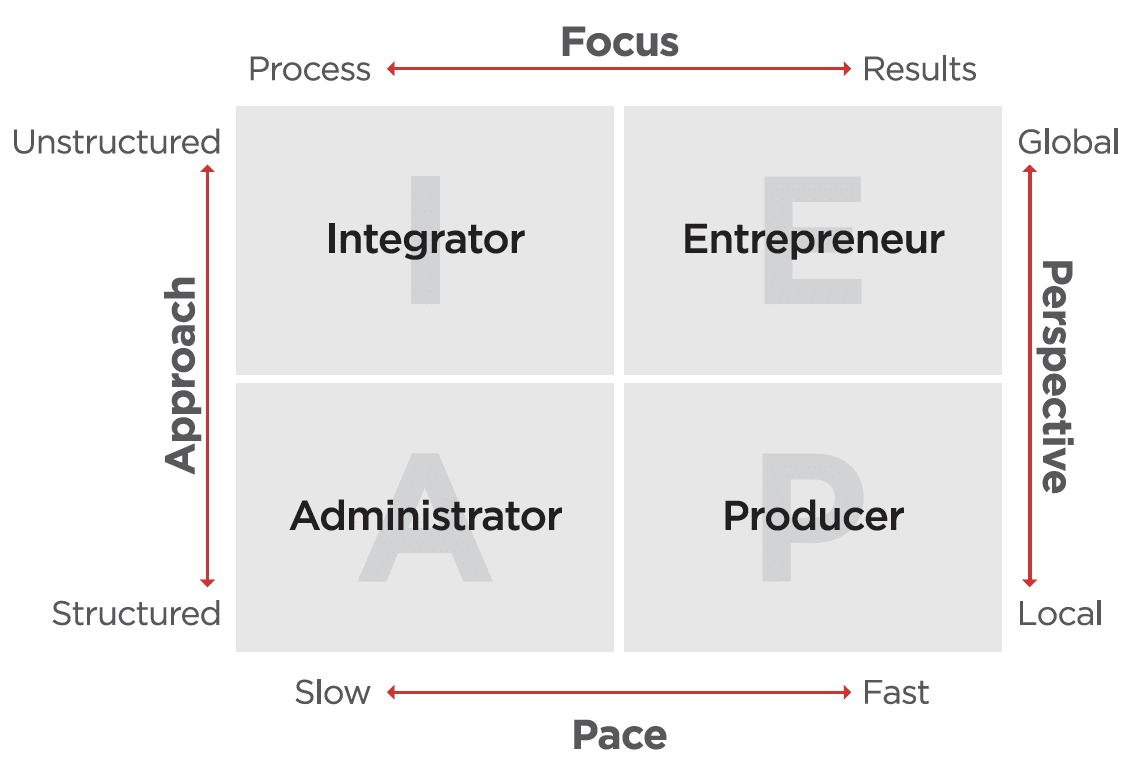
The corporate world’s version of APEST is what Adizes calls the PAEI model. Try to spot the similarities here.
Entrepreneur – Entrepreneurs embrace change and inspire those around them, are focused on creating new opportunities or responding to threats, more willing to believe in visions and take significant risks.
Production – The Producer is typically very delivery focused. Desires outcomes, results, obsessed with the customer experience. They work long hours to ‘do it now’
Administration – The administrator undertakes activities aimed at getting things optimized, efficient and aligned by capturing the learning curve about how to do things right in processes, procedures, systems.
Integration – Integrators are reliable, trustworthy, warm, and caring, focuses on the development of healthy teams and persistent cultures of mutual trust and mutual respect.
While imperfect, I think you can see the overlap of Entrepreneur to Apostle, Producer to Evangelist, Administrator to Teacher, and Integrator to Shepherd. What about prophets? Adizes mentions the essential role of “consultants” at each stage of corporate life to avoid damaging blind spots, see where we are, where we’re going, and offer us timely warnings and insights. Sound familiar?
The 10-Stages of Corporate Lifecycles – and How the Core Functions are Properly Deployed for Growth, or Misappropriated for Decline
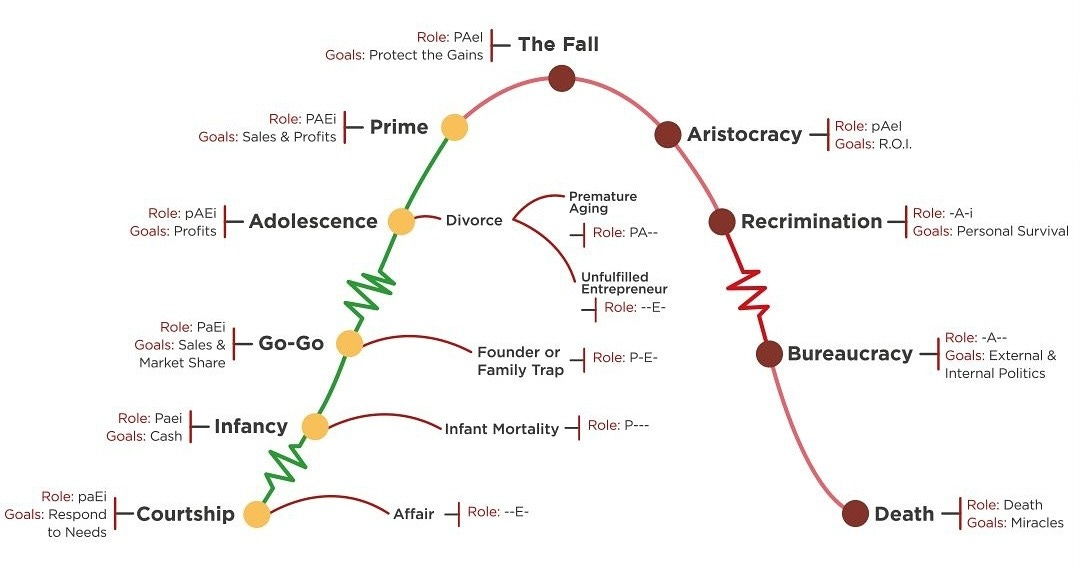
A quick word on how to read this image which is directly from the Adizes Institute. Each stage describes the target “Goal”, and the ideal deployment of the “Roles” by giving each of the PAEI functions a dash for non-existence, a lower case letter for present but low priority, or upper case letter for high priority.
As an example, you can see in “Courtship” (the pre-birth potential for an emergent corporation) is only high in “entrepreneur” function because of the capital “E”, and is low but not vacant of the other three functions. The early death risk is “Affair”, where the entrepreneur function is never grounded by the other functions (three dashes for the non existent functions), and gets distracted by a love affair with too many visions.
Look at all the church life parallels in this single graphic, the insights countless and overwhelming, here’s just a few:
- There is not a single life stage where all the functions are capitalized. This is an acknowledgement from Adizes that stewarding the four functions is constantly dynamic and a perfect, static-state harmony is an elusive dream.
- Ideal Prime stage is majoring in three outward functions, and the only function that is present but slightly lower priority is internal integrator. The moment that internal integrator function becomes a capitalized priority, is the first stage of a declining trajectory.
- Infant Mortality = lots of fruit but no attention given to the trellis (administration and integration)
- By prioritizing teaching and shepherding leadership for decades, the church has potentially embraced the declining phases of Aristocracy & Recrimination as the status quo.
- Adolescence stage can feel like a brief pause on hyper growth production, in order to recalibrate both internal capacity and vision for the next phase of scale (Prime!)
- A Corporation in decline loses its vision first, loses production second, is left only with its internal functions for survival, eventually loses its heart/team, and dies slowly as an administrative apparatus waiting for a miracle.
What other insights do you find compelling from this corporate lifecycles framework that can be helpful wisdom, warnings or insights for the church today? May we continue to recover the original 5-fold imagination for church life and leadership as we plant, build and multiply simple church movements obsessed with Jesus and His Kingdom breaking in everywhere in every way.